

Article
[ blog ]
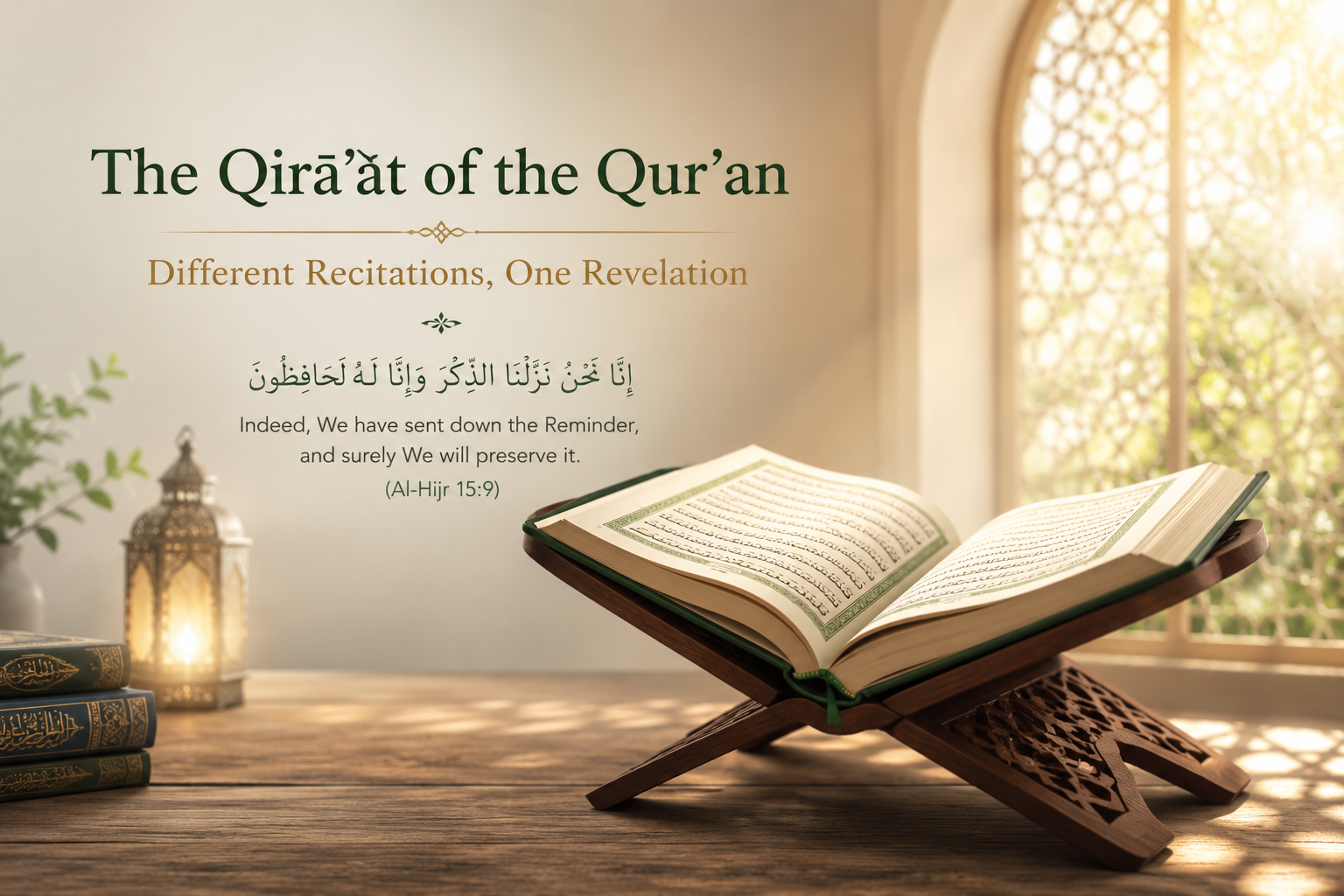
The Beautiful Story of the Qirā’āt
- Why Muslims Recite the Qur’an in Different Ways — And Why All of Them Are From Allah
Many Muslims who are new to Islam — especially non-Arab Muslims — experience a moment of surprise when they first hear two people reciting the Qur’an differently.
Perhaps someone memorized Sūrah al-Fātiḥah one way, then suddenly heard another reciter pronounce a word differently.
At first, this can feel confusing.
At first, this can feel confusing.
“Wait… why is it different?”
“Did someone change the Qur’an?”
“Which recitation is the real one?”
“Did someone change the Qur’an?”
“Which recitation is the real one?”
These questions are completely natural, especially for someone who deeply loves the Qur’an and wants to protect it in their heart.
But what many people discover later is something truly beautiful:
The different authentic recitations of the Qur’an are not mistakes.
They are not corruption.
They are not human edits or competing versions.
They are not corruption.
They are not human edits or competing versions.
Rather, they are part of the miracle of the Qur’an itself.
The science that studies these recitations is called ʿIlm al-Qirā’āt — the Science of Qur’anic Recitations — and it is one of the most precise and carefully preserved sciences in Islamic history.
To understand the qirā’āt, we must return to the time of the Prophet Muhammad ﷺ.
The Qur’an was not revealed as a printed book descending from the sky.
It was revealed gradually, verse by verse, through the Angel Jibrīl (Gabriel), over more than twenty years.
It was revealed gradually, verse by verse, through the Angel Jibrīl (Gabriel), over more than twenty years.
Every time revelation came, the Prophet ﷺ memorized it perfectly and then taught it to his companions exactly as he received it.
But the Arabs at that time were not one single tribe with one single accent. Different tribes pronounced certain words differently. Some pronunciations were easier for one tribe and harder for another.
Out of mercy, Allah allowed the Qur’an to be recited in multiple authentic forms — all revealed by Him.
So when the companions recited differently, they were not contradicting each other. They were reciting different revealed forms taught by the Prophet ﷺ himself.
Imagine two companions hearing each other recite slightly differently and becoming worried. This actually happened during the lifetime of the Prophet ﷺ. When they brought the matter to him, he did not say one was right and the other wrong. Instead, he confirmed that both recitations had been taught to him by Jibrīl.
This is a very important point:
The qirā’āt did not originate from scholars centuries later.
They originated from revelation.
They originated from revelation.
Every authentic qirā’ah traces back:
-
from student to teacher,
-
from teacher to earlier teacher,
-
back to the companions,
-
back to the Prophet ﷺ,
-
back to Jibrīl,
-
and ultimately back to Allah.
As centuries passed, Muslim scholars dedicated their lives to preserving these recitations with extraordinary precision.
They did not simply accept any variation someone claimed. The scholars established strict conditions before recognizing a recitation as authentic.
A valid qirā’ah had to:
-
have a continuous authentic chain to the Prophet ﷺ,
-
agree with the written Muṣḥaf preserved by the companions,
-
and conform to the Arabic language revealed in the Qur’an.
Because of this careful preservation, the qirā’āt became one of the most rigorously transmitted oral traditions in human history.
Even today, students of Qur’an often spend years mastering just one recitation under qualified teachers.
One of the most beautiful things about the qirā’āt is that the differences usually add meaning rather than create contradiction.
For example, in Sūrah al-Fātiḥah, some reciters read:
مَالِكِ يَوْمِ الدِّينِ
which means:
“Master of the Day of Judgment.”
Other authentic reciters read:
مَلِكِ يَوْمِ الدِّينِ
which means:
“King of the Day of Judgment.”
At first glance, someone unfamiliar with qirā’āt may think this is a contradiction.
But in reality, both meanings are true about Allah.
But in reality, both meanings are true about Allah.
Allah is the King, and Allah is the Master.
Instead of weakening the meaning, the two recitations enrich it. They open deeper layers of reflection and beauty.
This is one reason scholars often describe the qirā’āt as part of the miracle of the Qur’an.
Today, Muslims around the world still recite using different authentic qirā’āt.
The most widespread recitation today is the recitation of Ḥafṣ from ʿĀṣim. Many Muslims assume this is the “only Qur’an,” simply because it is the one most commonly printed.
But in countries such as Morocco, Algeria, and parts of Africa, many Muslims recite using other authentic recitations that have also been preserved for centuries.
And despite these differences, the Qur’an remains one.
The message is one.
The beliefs are one.
The religion is one.
The beliefs are one.
The religion is one.
No authentic qirā’ah changes the foundations of Islam.
Perhaps the most amazing part of all this is what it tells us about the preservation of the Qur’an.
If the Qur’an had truly been altered by people over history, we would expect chaos, contradictions, and confusion. We would expect endless competing versions with no clear origin.
Instead, what we find is a highly organized, carefully documented, meticulously transmitted system preserved generation after generation across more than fourteen centuries.
This itself is a sign of divine protection.
Allah says:
And part of that preservation includes preserving the authentic qirā’āt themselves.
For many students, learning about qirā’āt changes the way they see the Qur’an forever.
What first appeared confusing becomes a source of awe.
They begin to realize that the Qur’an is not fragile.
It is vast, precise, living, and miraculously preserved.
It is vast, precise, living, and miraculously preserved.
The qirā’āt are not different “versions” fighting against one another.
They are different windows opening onto the same divine revelation.
They are different windows opening onto the same divine revelation.
And every authentic recitation carries the same sacred origin:
From Allah…
through Jibrīl…
to Muhammad ﷺ…
to the Ummah.
through Jibrīl…
to Muhammad ﷺ…
to the Ummah.